- Home
- Our Community
- Our Faith
- Sacraments at St. Francis
- Parish Life
- Bulletin
- Contact Us
- Search

FIVE THINGS YOU SHOULD KNOW ABOUT ST. MARTIN OF TOURS | Feast Day: November 11th
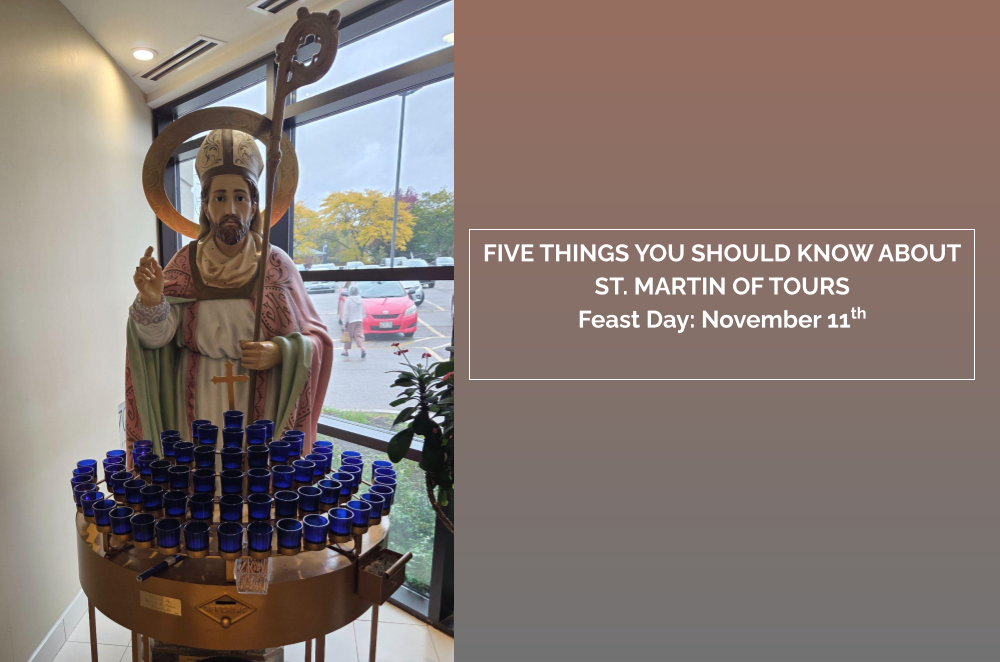
- St. Martin was drafted into the Roman army at age 15.
As a young soldier, St. Martin was discontent with military life. He began learning about Christianity and felt that it promoted a message of peace and consideration for one’s fellow man that was inconsistent with life as a Roman soldier. At one point, Martin even wrote to the Emperor requesting to be released from service, stating: “I am Christ’s soldier: I am not allowed to fight.”
- He had a dream where Jesus visited him.
God used a chance encounter with a stranger to change Martin’s heart. Once, when Martin was stationed near Amiens, France, he came across a nearly naked beggar on a cold winter’s day. Overcome with pity, Martin felt compelled to tear his cloak in two and give the beggar half; later that night, he had a dream that Jesus was wearing the other half of his cloak. The dream inspired him to become baptized immediately.
- St. Martin was imprisoned on charges of cowardice for refusing to fight.
Following his conversion, Martin remained in the army, but refused to fight, making him “the first recognized conscientious objector in recorded history.” Because of this, Martin was imprisoned on charges of cowardice, but was later released.
- He lived for a time as a hermit on an island.
Upon quitting the army, Martin sought solitude on an island in the Gulf of Genoa. However, God was not done using Martin to help others, and he later returned to civilization to found the first monastery in Gaul. Despite his protestations, he was eventually made Bishop of Tours, but still lived the life of an unassuming monk. He was instrumental in reaching out to unchurched people in the countryside, bringing the Gospel to many who might not otherwise have heard it.
- St. Martin’s feast day has traditionally been used as a day to sign peace treaties.
Because of his love of peace, St. Martin of Tours’ feast day has traditionally been used as a day to sign peace treaties. One of the most significant of these treaties was the Treaty of Versailles, which ended World War I.
Source: https://www.nationalshrine.org/blog/5-things-you-should-know-about-st-martin-of-tours/